

Optellum Awarded NIHR Funding for Multi-Site NHS Pilot Study for Accelerated Lung Cancer Diagnosis
OXFORD, United Kingdom and HOUSTON, June 15, 2026 – Optellum, a leader in AI-enabled lung cancer diagnostics, today announced it has been awarded funding for a competitive programme, Invention for Innovation (i4i), focused on transformative and disruptive innovations to reduce waiting lists and waiting times, from the National Institute for Health and Care Research (NIHR) to support the SWIFT LUNG project (Streamlined Workflow for Investigation and Fast Tracking Lung Cancer Diagnosis). The three-year programme will evaluate how AI-supported workflows can help NHS organisations reduce delays in lung cancer diagnosis while improving consistency, efficiency, and the patient experience.
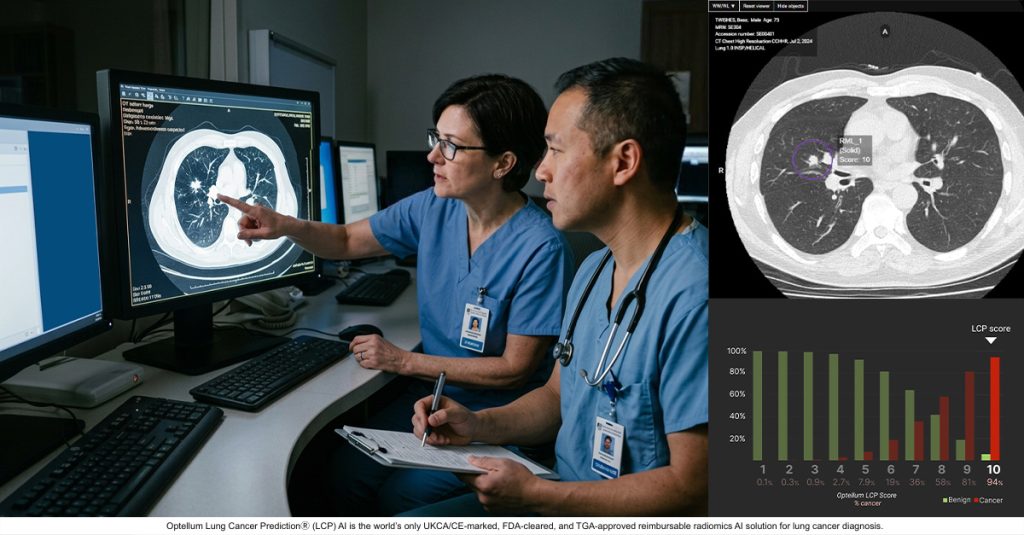
Lung cancer remains the leading cause of cancer-related deaths in the UK, with delays in triage and follow-up to CT imaging leading to worse patient outcomes and strain on NHS diagnostic services. The SWIFT LUNG project is designed to address these challenges by embedding Optellum’s UKCA/CE-marked, TGA-approved and FDA-cleared Virtual Nodule Clinic (VNC) solution into existing lung nodule and lung cancer pathways. Notably, the VNC platform integrates two core AI capabilities: the Patient Safety Net (PSN) for automated identification of patients with lung nodules from CT reports, and the Lung Cancer Prediction (LCP) model to calculate individualized malignancy risk. Together, these tools support clinicians in identifying, tracking, and assessing lung nodules, while prioritising high-risk cases and minimising unnecessary follow-ups for benign findings in line with national guidance.
Previous studies in NHS populations have shown that LCP more accurately distinguishes benign from malignant nodules than the Brock (PanCan) risk model and can safely rule out over twice as many low‑risk nodules without increasing missed cancers, substantially reducing unnecessary CT surveillance and freeing up diagnostic capacity. SWIFT LUNG will be conducted as a prospective, stepped-wedge clinical trial across multiple NHS sites in England and Scotland, including NHS Greater Glasgow and Clyde, NHS Highland, and Oxford University Hospitals. The project also includes health-economic analysis and qualitative evaluation to understand cost-effectiveness, acceptability, and actual implementation, in addition to evaluating clinical effectiveness at reducing time-to-triage.
“Optellum is honoured to have been selected and trusted for the SWIFT LUNG project to help NHS teams improve lung cancer care pathways. This project shows how committed we are to supporting health systems with responsible, evidence-based innovations that have real-world impact for patients and providers,” said Johnathan Watkins, PhD, Optellum’s CEO. “Most importantly, we want to help patients get the timely care they need and potentially reduce the uncertainty that often comes with receiving a lung cancer diagnosis. We are excited to work with the NHS to make this goal a reality for patients and entire health systems.”
Dr Mark Hall, Consultant Radiologist at NHS Greater Glasgow and Clyde and Chief Investigator for SWIFT LUNG, said: “Pulmonary nodules are commonly identified on CT scans, but ensuring every patient receives the right follow-up at the right time remains a major challenge across healthcare systems. SWIFT LUNG aims to close that gap by using AI to help identify, risk assess and track patients through a structured pathway.”
“This is about giving radiology and lung cancer teams better tools to manage complex information, reduce variation, and improve patient safety. not replacing clinical judgement or radiologists.”
Dr John MacLay, Lung Cancer Lead at Glasgow Royal Infirmary and Clinical Lead for SWIFT LUNG, said: “We hope that SWIFT LUNG will demonstrate the real-life utility of Optellum’s Virtual Nodule Clinic, ensuring all pulmonary nodules identified and reported on CT scans are reviewed and appropriate follow up is implemented.”
“This AI-driven solution has the potential to reduce the clinical risk of missed nodules that may represent early lung cancers and accelerate the diagnostic pathway to allow early curative intervention.”
Professor David Lowe, Director of Clinical Innovation at the University of Glasgow and Lead of the HealthTech Innovation & Translation Lab, said: “Despite advances in imaging and pathway design, a substantial proportion of lung cancers in the UK are still diagnosed at a late stage.”
“SWIFT LUNG addresses this by generating robust, real‑world evidence on whether AI-enabled triage approaches – such as Optellum’s Virtual Nodule Clinic – can be safely and effectively integrated into routine practice to support earlier identification of high-risk nodules.”
“The study focuses on measurable impact, including time to triage, time to diagnosis, and the timely escalation of patients with high‑risk findings.”
“This is about helping clinical teams to ensure that actionable findings are identified promptly and not missed, ultimately improving outcomes for patients.”
Dr Beth Sage, Consultant Respiratory Physician, Director R&D and Innovation at NHS Highland and Clinical Lead for SWIFT LUNG, said: “The introduction of AI-supported decision tools like Optellum represents an important step forward in how we manage lung nodules. Within SWIFT LUNG, this innovation will help us deliver more timely, equitable, and evidence-based care for patients across the Highlands, where distance should never be a barrier to high-quality care.”
Dr Ambika Talwar, Consultant in Respiratory Medicine at Oxford University Hospitals NHS FT and Clinical Lead for SWIFT LUNG, said: “At Oxford University Hospitals, we recognise that timely identification and escalation of high-risk lung nodules remain one of the most critical challenges in improving early diagnosis. SWIFT LUNG offers a unique opportunity to evaluate the real-world impact of AI-assisted triage using Optellum’s technology on time to diagnosis and patient outcomes, and to provide the evidence for improvement of our current pathways.”
Results from the study will be shared with clinicians, healthcare leaders, and policymakers through peer-reviewed journals, conference presentations, and NHS business cases. This will help reach the broader goal of reducing diagnostic delays and improving outcomes and experience for patients with suspected lung cancer.
About Optellum
Optellum is a commercial-stage AI healthcare company dedicated to revolutionising early diagnosis and treatment of lung disease, starting with one of the deadliest, lung cancer.
Optellum’s flagship product, Virtual Nodule Clinic (VNC) with Lung Cancer Prediction AI (LCP), is the world’s first FDA-cleared and reimbursed software-as-a-medical-device (SaMD) solution for AI-powered lung cancer prioritisation and diagnostic support. Clinicians trust the Optellum solution to aid them in making the most appropriate life-saving treatment decisions for their patients. Backed by real-world clinical evidence, Optellum’s solution accelerates the diagnostic care pathway by enabling early patient identification, enhancing prioritisation, and improving clinicians’ efficiency, reducing time to guideline-recommended treatment. Optellum VNC is FDA cleared, CE-MDR marked, UKCA marked, and TGA-approved.
Optellum is headquartered in Oxford, UK, and has an office at the Texas Medical Center in Houston, Texas, US.
Media Contact
Philippe Freund
Head of Marketing and Market Development
marketing@optellum.com
Recent posts